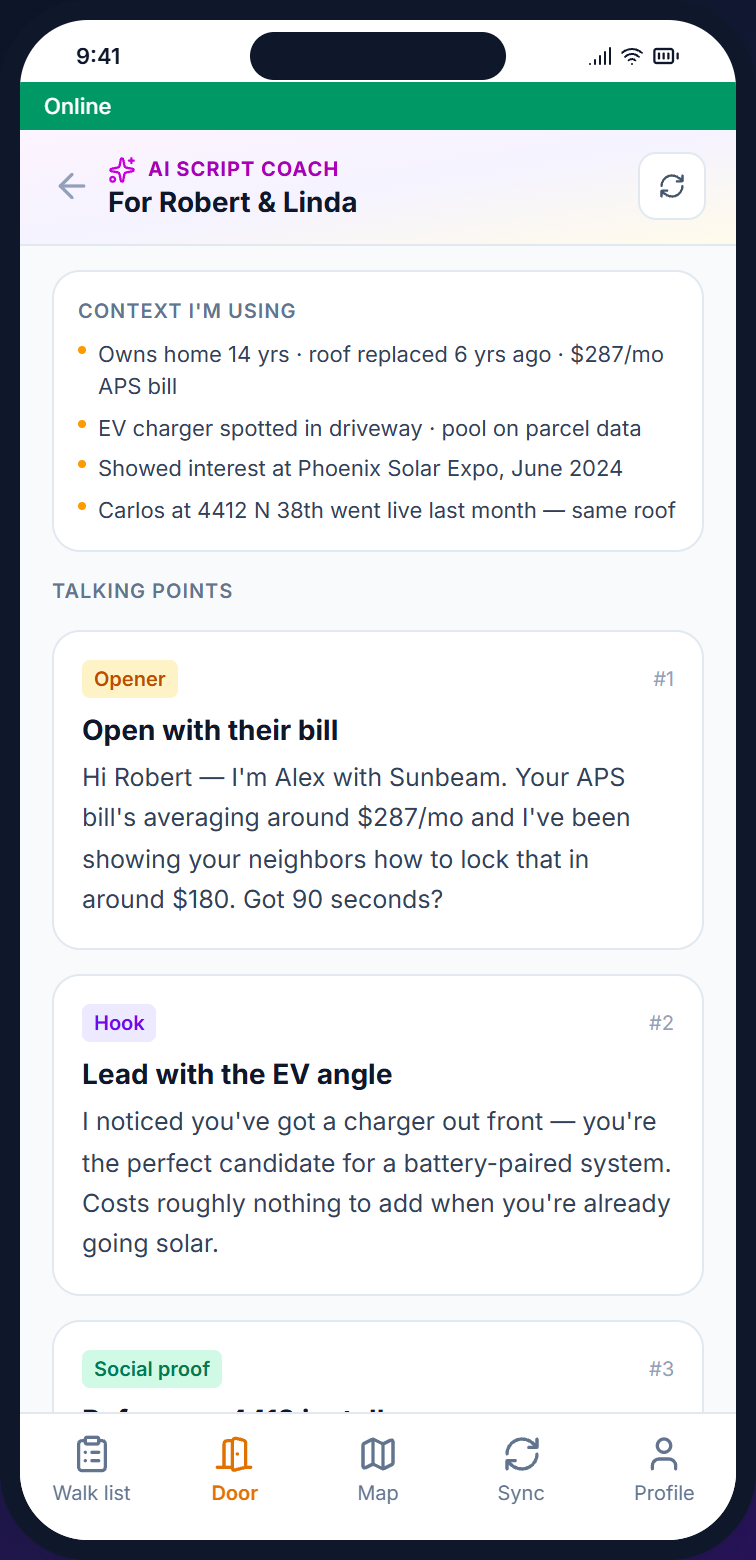
Beacon manages canvassing, the door-to-door side of a campaign. You import the voter file (the official list of registered voters), divide precincts, and send walk lists (the addresses each canvasser will visit) to canvasser phones. A live dashboard shows your GOTV (getting out the vote) coverage. It is built for how state-house and federal field programs are organized.
Territories
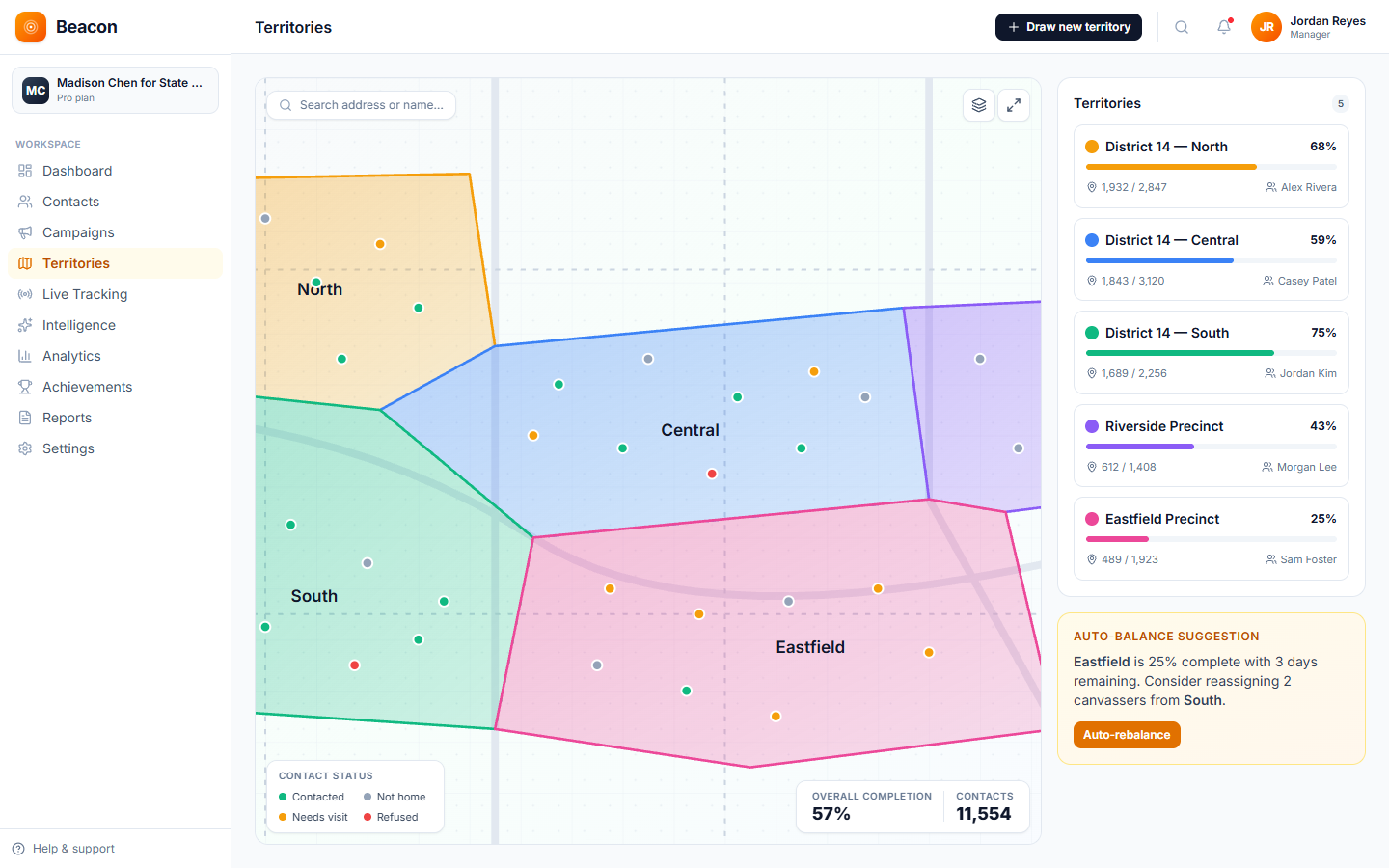
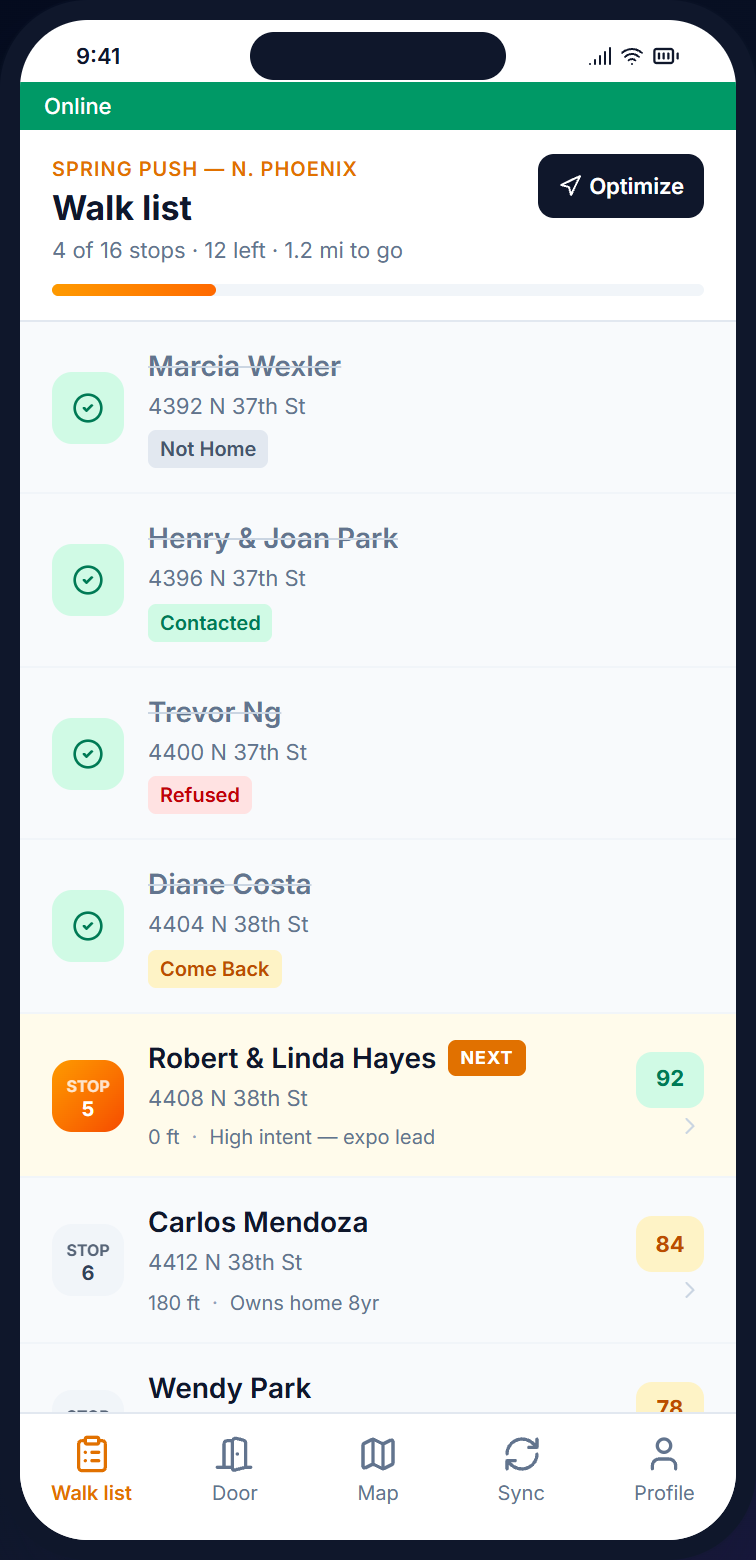
Draw a shape around a precinct on the map, name it, and assign canvassers. The voters inside the boundary become a walk list, ordered by street so canvassers do not walk the same blocks twice. If your target voters change during the campaign, redraw the territory and the walk lists update to match.
The platform
Every door visit is saved to the same record the field director sees on the GOTV map, so there are no paper walk sheets to collect and no end-of-night spreadsheets for the data director.
/01, DESK
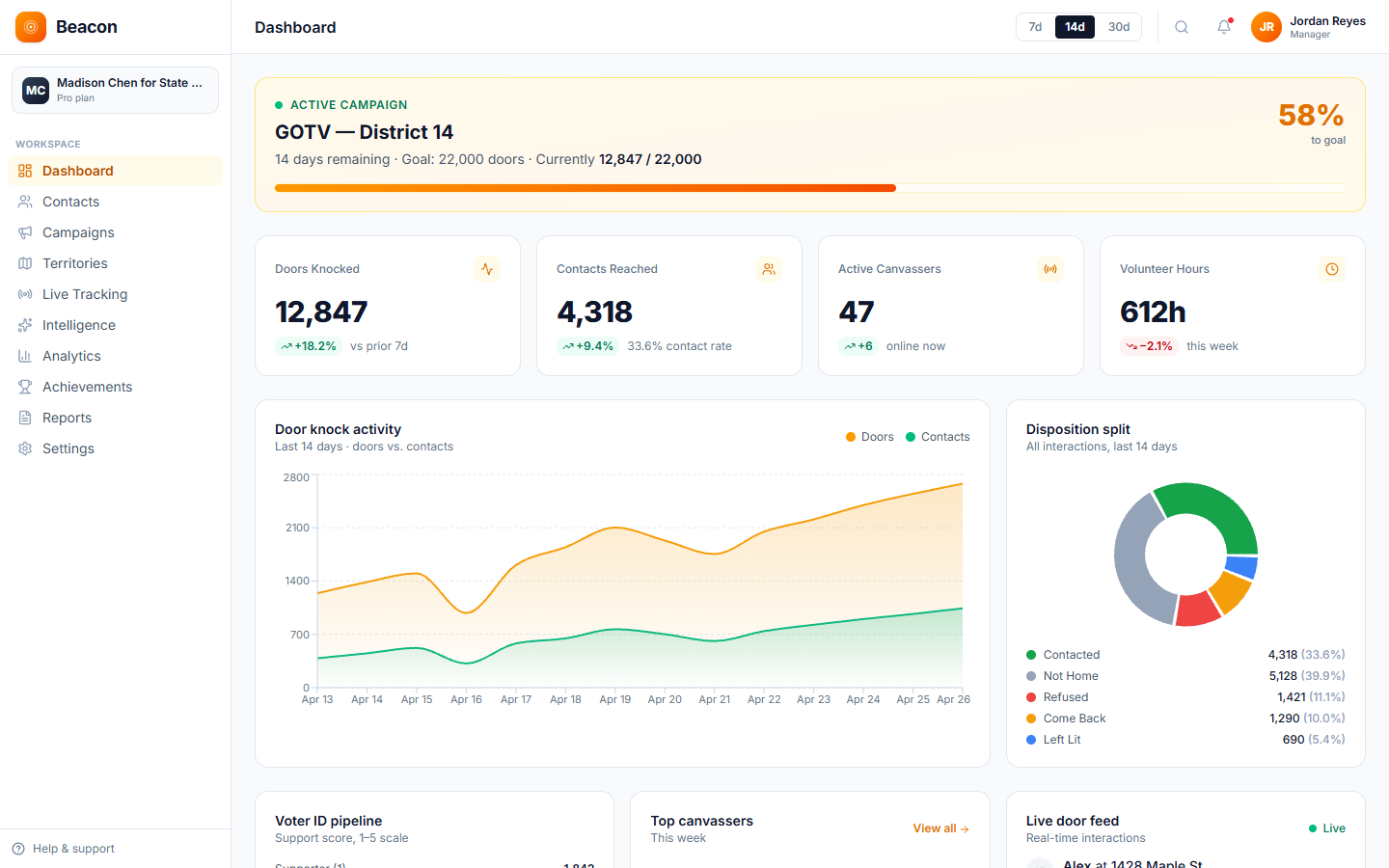
The office screen where you divide precincts, write scripts, and assign canvassers. Its live GOTV map fills in as the team works through its turfs (the areas assigned to each canvasser). The campaign manager and consultants see the same view.
/02, DOOR
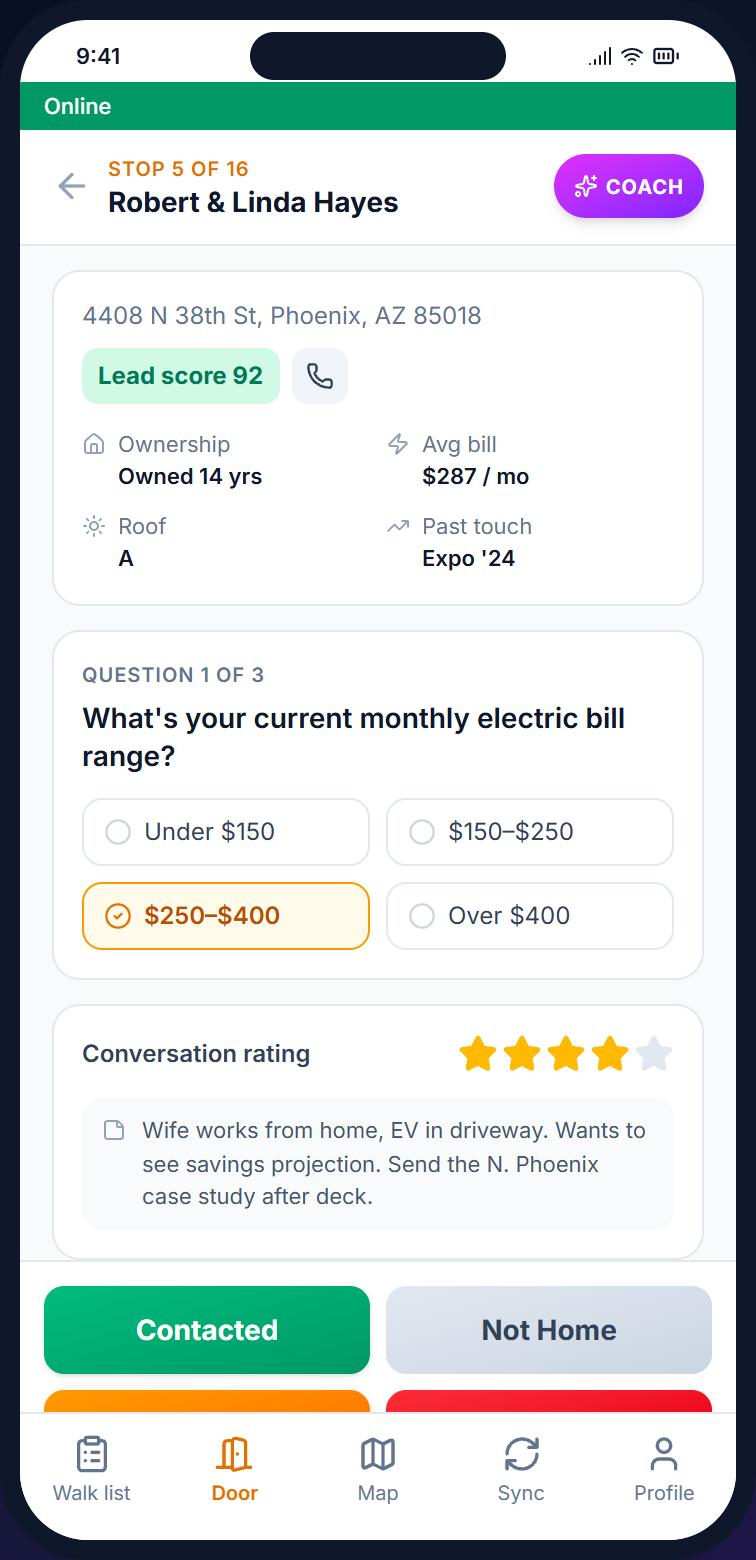
The phone app for canvassers. It holds the walk list, the voter screen, the AI Script Coach (a paid add-on), and an upload queue. Anything recorded without cell signal is saved on the phone and uploaded when the connection returns.
/03, MAP
Each door visit updates the map as it happens. The dashboard shows coverage by precinct, door results by canvasser, and the share of voters identified by neighborhood, so no one needs to run a report.
Campaign types
A state representative's persuasion canvass and a 72-hour GOTV effort record different information. Beacon is set up around what each program records, so the same account handles both without being rebuilt between elections.
Work from a targeted list of supporters, with a shorter set of door results and a drop-off mode for early-vote runs. The GOTV dashboard shows coverage and turnout as they happen, so the field director can move people where needed.
Captures: Voted · Not Yet · Wrong Address · DNC
Earlier in the campaign, canvassers rate each voter's support from 1 to 5 (often called voter ID), ask issue survey questions, and flag people for fundraising or volunteer follow-up. Each conversation adds new information to the voter file.
Captures: Support 1-5 · Issue Priority · Follow-Up · Volunteer
It is for finance teams that visit a donor list rather than a voter list. Suggested amounts appear at the door, follow-up flags go to the call dialer, and door results copy to the campaign record, so no one has to match records after the shift.
Captures: Pledge · Follow-Up · Hard No · Already Maxed
How a precinct gets walked
The steps are the same for a 220-door city council race and a 12,000-door state-house campaign. Most teams can finish the setup in an afternoon.
/01
Bring a CSV export from your voter database or vendor, or your state voter file. During import, Beacon matches each VoterID, reads party affiliation, and places every voter on the map.
/02
Draw territories on the map, and the target voters inside each one become a walk list. Each turf shows how many doors it holds, so you can see when one has too many or too few.
/03
At each door, canvassers use the door screen to record the result, support from 1 to 5, issue priority, and follow-up flags. This works offline, and the records upload as soon as signal returns.
/04
Live coverage, the split between persuasion and ID contacts, and top performers are totaled automatically. At the end of the campaign, you export a file the data director uploads to your voter database.
On the doorstep
The voter screen shows the voter's party, lead score, and earlier contacts. With the paid add-on, the AI Script Coach uses that to suggest a one-line opening for the household. The app keeps working offline and uploads records when cell signal returns.
See how canvassers use it →
Campaign FAQ
/Q, VOTER FILES
Yes. The CSV import matches VoterIDs and brings in party affiliation, vote history, and district codes. Standard CSV exports from common voter data vendors and most state voter files also import without problems.
/Q, PRICING
No. Pricing is based on the number of voters on your list (contacts), not the number of volunteers, so 5 canvassers or 500 cost the same. There are six tiers, from Starter at $59 (2,500 contacts) up to Enterprise at $599 (250K+).
/Q, OFFLINE
Yes. The mobile app keeps working without cell signal. Door results are saved to the phone and uploaded to the server when the connection returns, so results from basements, rural routes, or parking garages are not lost.
/Q, COMPLIANCE
Donor occupation and employer fields are built in for finance teams. Permission to text (SMS opt-in) is recorded at the door, the DNC (do-not-contact) list is enforced by default, and every record has an audit log.
/Q, INTEGRATION
The CNX Suite has four products: Beacon, CampaignCNX+, Alma, and CoreCNX (a CRM). They can be bought together on one bill, and you sign in to each with the same email address. CampaignCNX+ is a separate texting product with its own plans and its own account, and a door result in Beacon does not start a CampaignCNX+ text. Beacon door results, appointments, and contact status are added to the voter's record in CoreCNX. Alma, the website chatbot, is also a separate product with its own account.
/Q, SETUP
Most campaigns are visiting doors within three days of signing up. The account is live the same day. The voter file imports while you draw your first territory, and walk lists are on canvasser phones by the next morning. A real person, not a chatbot, handles onboarding.
Get started
Open an account, import your voter file, and draw your first territory. Within a few days, your canvassers will be visiting doors with walk lists in street order on their phones, plus the AI Script Coach if you add it.