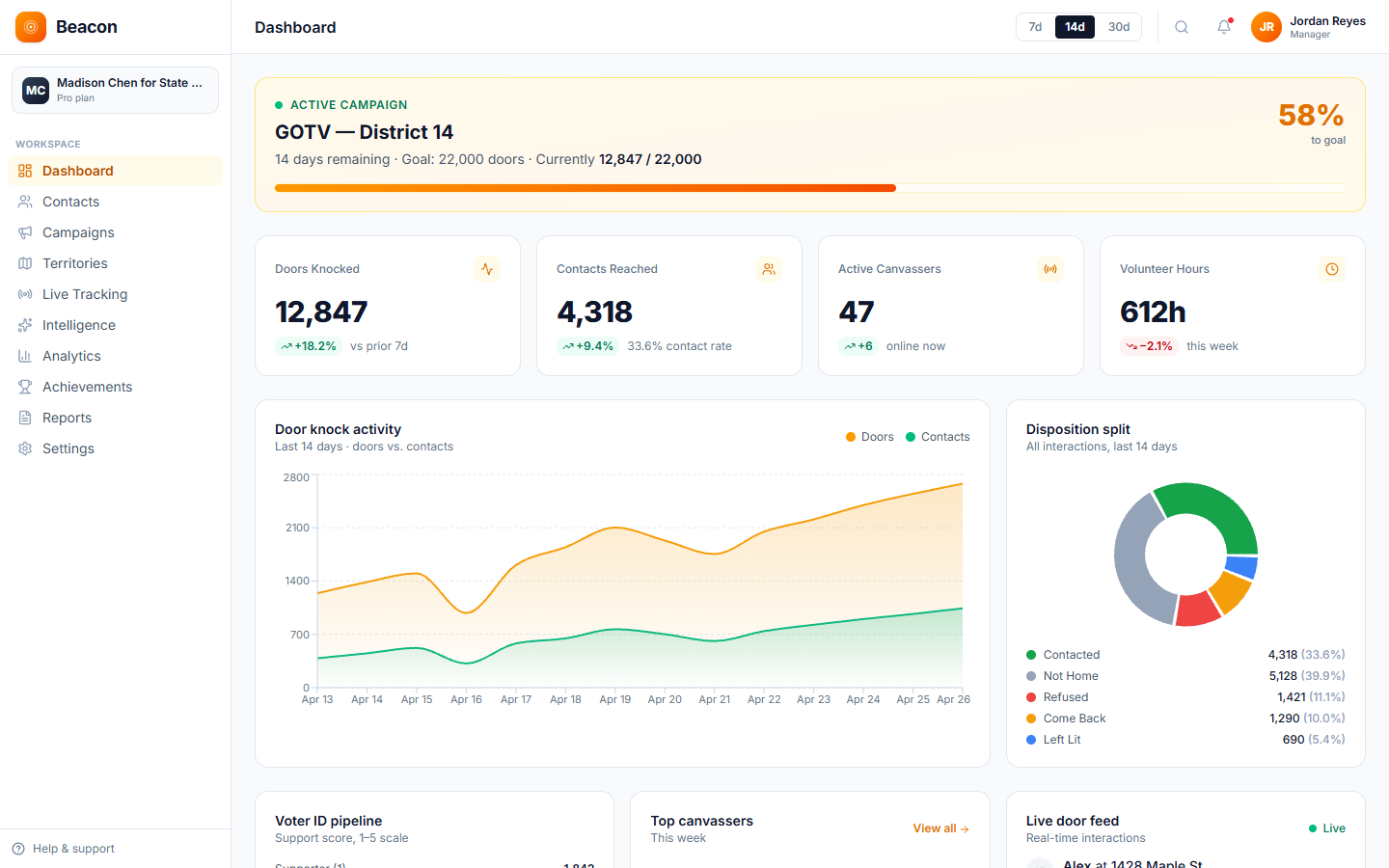
Beacon manages the field side of a labor program, including canvassing (visiting workers and members at home to talk in person). You import member lists, divide shops and neighborhoods, and send visit lists to steward phones. A live dashboard shows how many authorization cards (cards workers sign to show they want a union) organizers have recorded as signed. Beacon does not collect the card signatures. It records each conversation, the card status, and the follow-up at the door, with GPS and a timestamp. Visit history stays on each member's record across shift changes, so lead organizers and stewards work from the same record.
Territories
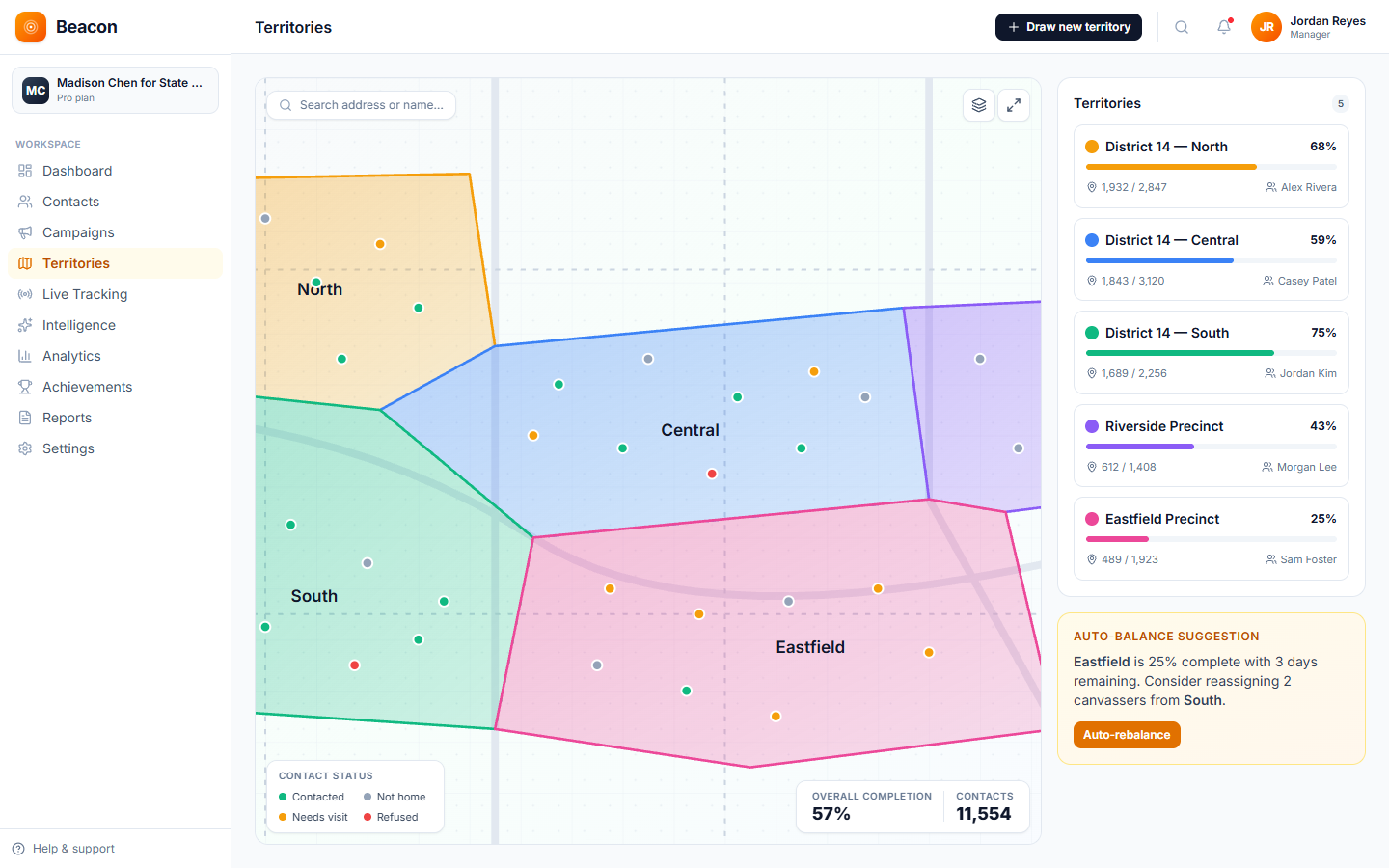
Draw a shape around a shop's location or a member neighborhood, name it, and assign organizers and stewards. The members inside the boundary become a visit list, ordered by street so organizers making house calls do not cover the same blocks twice.
The platform
Every house call is saved to the same record the campaign director sees on the support map, so there are no paper card stacks or spreadsheet hand-offs the night before filing.
/01, DESK
The office screen where you divide shops and neighborhoods, write talking points, and assign organizers. Its live support map fills in as the team works through its visit lists. The campaign director reviews the same view before every check-in.
/02, DOOR
The phone app for stewards. It holds the visit list, the member screen, the AI Script Coach (a paid add-on), and an upload queue. Anything recorded without cell signal is saved on the phone and uploaded when the connection returns.
/03, MAP
Each visit updates the map as it happens. The dashboard shows cards collected by shop, support level by shift, and the most pressing grievances by department, so no one needs to run a report.
On the porch
When one steward records grievances, support level, and a follow-up flag at a house call, the next steward at the same door can see that history: shift, family details, the issues that matter, and what was said last time. The member does not have to start over on the third visit.
How a drive runs
The steps are the same for a 60-worker drive at a single shop and a 2,400-worker campaign across several sites. Most committees can finish the setup in an afternoon.
/01
Bring a worker list, member roster, or payroll export. Roles and shifts are tagged during import, and every address is placed on the map.
/02
Draw shapes around shops, departments, and neighborhoods, and the members inside become a visit list. Each turf (the area assigned to one organizer) shows how many members it holds, so you can see when one has too many or too few.
/03
At each door, organizers use the door screen to record support from 1 to 5, grievance survey answers, and each worker's card status. This works offline, and the records upload as soon as signal returns.
/04
Live coverage, support by shift, and top organizers are totaled automatically. At filing time, you export the records with timestamps and GPS data intact for counsel review.
Drive types
An organizing drive at a non-union plant and a contract-education effort for an existing local record different information. You set up Beacon around what each program needs to record, so the same account handles both.
House calls aimed at a supermajority of signed cards, with card status, support ratings from 1 to 5, and a record of the pushback workers report. The dashboard shows the card percentage by shift and shop as it changes, so the campaign director can move organizers where needed.
Captures: Card Signed · Strong · Leaning · Undecided · Hard No
Visit members before negotiations to record grievances, survey contract priorities, and identify who is ready to strike. The bargaining committee then has numbers from the whole membership instead of anecdotes from the room.
Captures: Top Issue · Strike-Ready · Steward-Interested · Grievance
After the local endorses candidates, members can canvass for them. Member-to-member persuasion, COPE requests (donations to the union's political fund), and GOTV (getting out the vote) efforts for the endorsed slate all use the same map and app, set to election mode.
Captures: Voted · Committed · Persuadable · Will Recruit
Organizer FAQ
/Q, CARDS
No. Workers sign authorization cards outside Beacon. Organizers use Beacon to record each house call, the card status, and the follow-up, and each record includes GPS coordinates and a timestamp. The records are stored securely with an audit log and can be exported for your counsel to review.
/Q, PRICING
No. Pricing is based on the number of members on your list (contacts), not the number of organizers, so 5 stewards or 50 cost the same. There are six tiers, from Starter at $59 (2,500 contacts) up to Enterprise at $599 (250K+).
/Q, OFFLINE
Yes. The mobile app keeps working without cell signal. Visits are saved to the phone and uploaded to the server when the connection returns, so support ratings recorded inside a warehouse or steel building are not lost.
/Q, SECURITY
Access depends on each person's role. Organizers see their own assignments, and lead organizers see the full campaign view. Member data is encrypted when stored, every view is logged, and management never gets the list.
/Q, INTEGRATION
The CNX Suite has four products: Beacon, CampaignCNX+, Alma, and CoreCNX (a CRM). They can be bought together on one bill, and you sign in to each with the same email address. CampaignCNX+ is a separate texting product with its own plans and its own account, and a door result in Beacon does not start a CampaignCNX+ text. Beacon door results, appointments, and contact status are added to the member's record in CoreCNX. Alma, the website chatbot, is also a separate product with its own account.
/Q, SETUP
Most drives are making house calls within three days of signing up. The account is live the same day. The member list imports while you draw your first turf, and visit lists are on steward phones by the next morning. A real person handles onboarding, and white-glove setup is available ($249 to $999).
Start organizing
Open an account, import your member list, and draw your shops. Within a few days, your stewards will be visiting members with lists in street order and a card-status tracker on their phones.