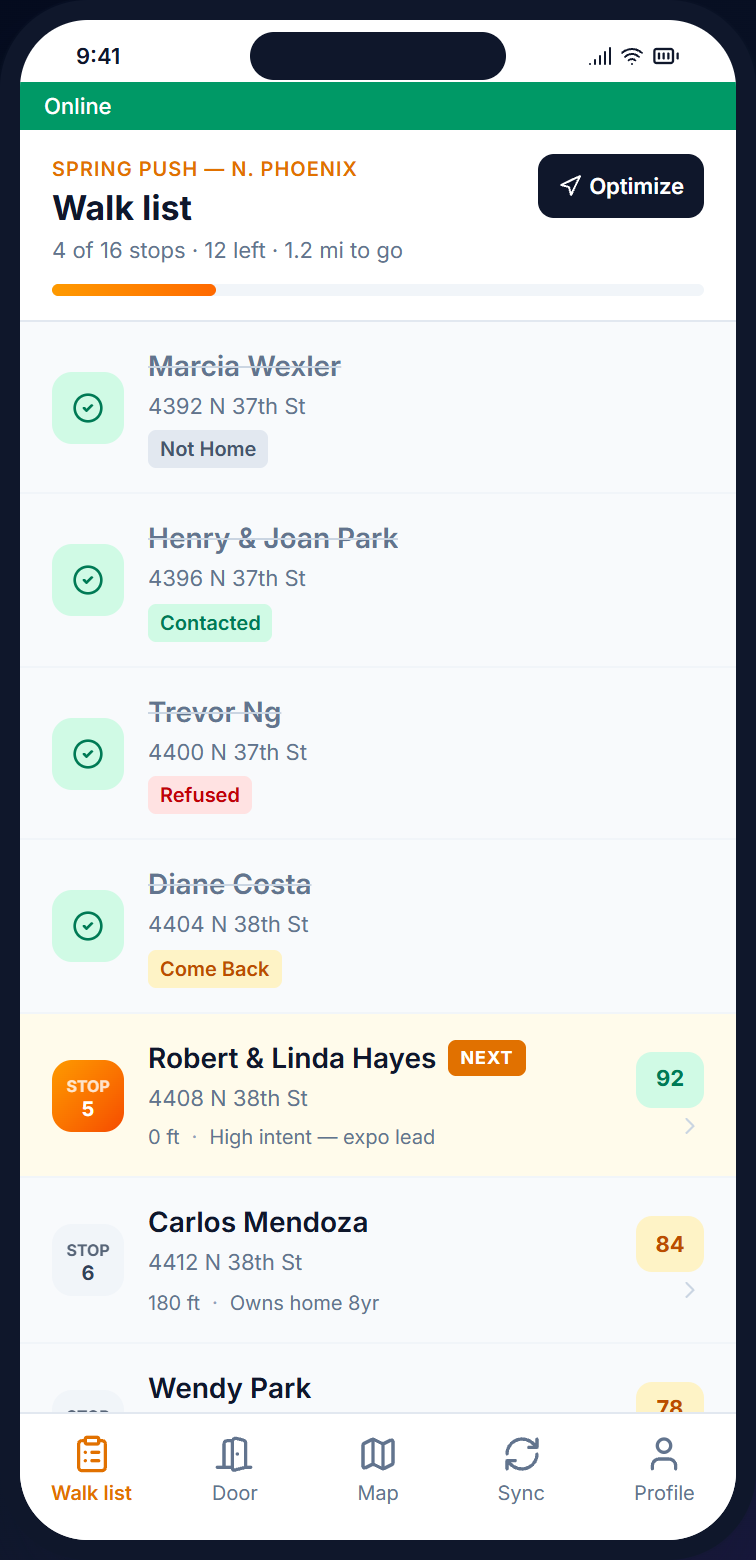
Beacon reorders the walk list (the addresses each canvasser will visit) by street, so each canvasser walks a short, sensible path instead of the order of the imported file. Priority leads are moved toward the front. To build the route, Beacon links each door to the nearest one not yet visited, then swaps stops to remove detours (the nearest-neighbor and 2-opt methods).
Capabilities
Each walk list arrives already in route order, and canvassers can tap any contact to open turn-by-turn directions in the phone's maps app. Priority leads are placed at the top of the route, so canvassers reach them early in the shift.
/01, SOLVER
Beacon builds a short, sensible route across every door on the list. The nearest-neighbor step creates a first route, and the 2-opt step removes obvious detours. A typical walk list is finished in well under a second.
/02, PRIORITY
High-score leads, contacts tagged as hot, and VIPs can each be moved earlier in the route, so priority doors are knocked first in the shift.
/03, HANDOFF
The route appears on the mobile map with stop numbers and the distance to the next door. Tapping a contact opens Apple Maps or Google Maps for directions.
Why it matters
An unsorted walk list sends canvassers back and forth, so they may cross the street four times when once would do. On a 100-door shift, that adds roughly an hour of walking. Once Beacon builds the route, the order follows the street grid.
How a route gets built
Run it once when the campaign starts, then run it again whenever your target list changes.
/01
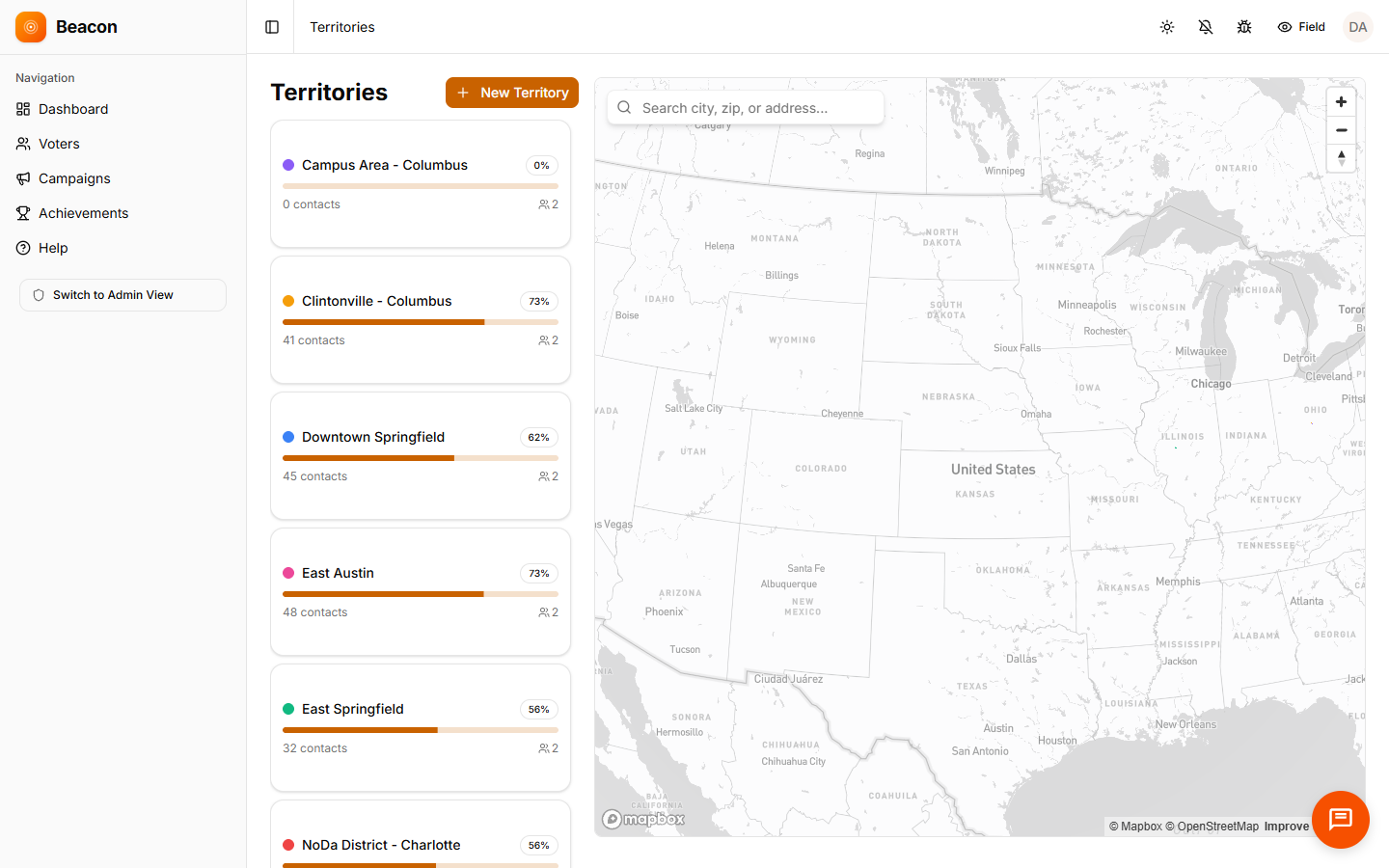
Choose a campaign and a turf (an assigned area). Beacon loads every contact in the walk list along with its location on the map.
/02
The route is calculated in your browser. The nearest-neighbor step builds a first route, the 2-opt step removes obvious detours, and the route appears on the map.
/03
Canvassers see the ordered list with stop numbers and distance markers. Tapping a stop opens directions in the phone's maps app.
/04
If you add canvassers, remove a turf, or change a list, run the route again. Canvassers' phones receive the new route the next time they update.
FAQ
Q / 01
The nearest-neighbor method creates a first route, and the 2-opt method then swaps stops repeatedly to shorten the path. This is a standard, practical approach to route planning. It does not guarantee the shortest possible route, but the result is very close in practice.
Q / 02
Lead score, tags, and statuses can each be set to move a contact earlier in the route. Set the rules once for the campaign, and they apply every time the route is rebuilt.
Q / 03
Yes, both. The solver keeps the total distance as short as possible, which works either way, and the mobile map opens Apple Maps or Google Maps for turn-by-turn directions.
Q / 04
The built-in solver handles up to roughly 500 contacts in well under a second. Larger programs, or programs with extra limits such as time windows or capacity, can use a solver that runs on Beacon's servers.
Start planning routes
Open an account, import a list, and click optimize. When the canvasser opens the app, the route is ready.