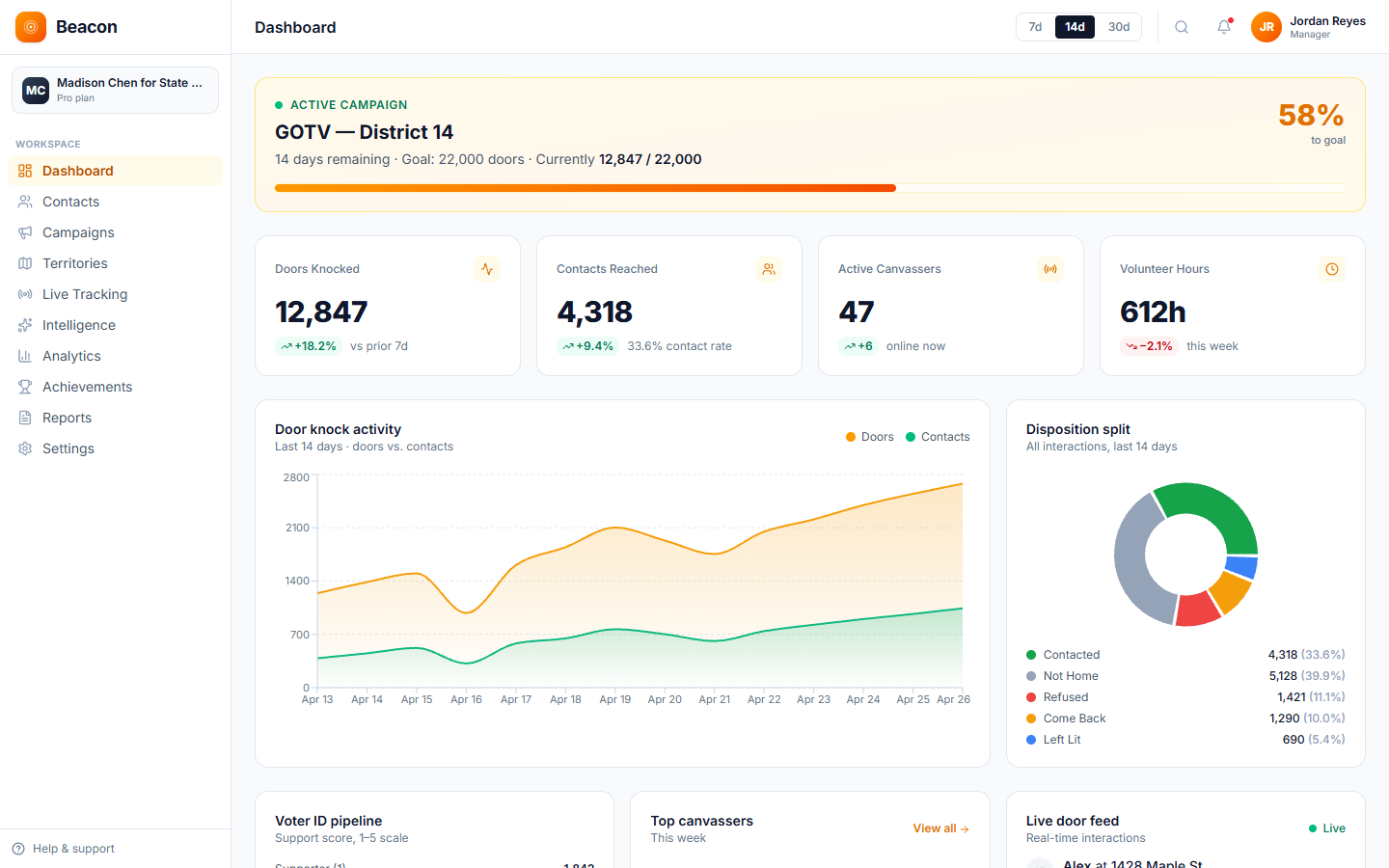
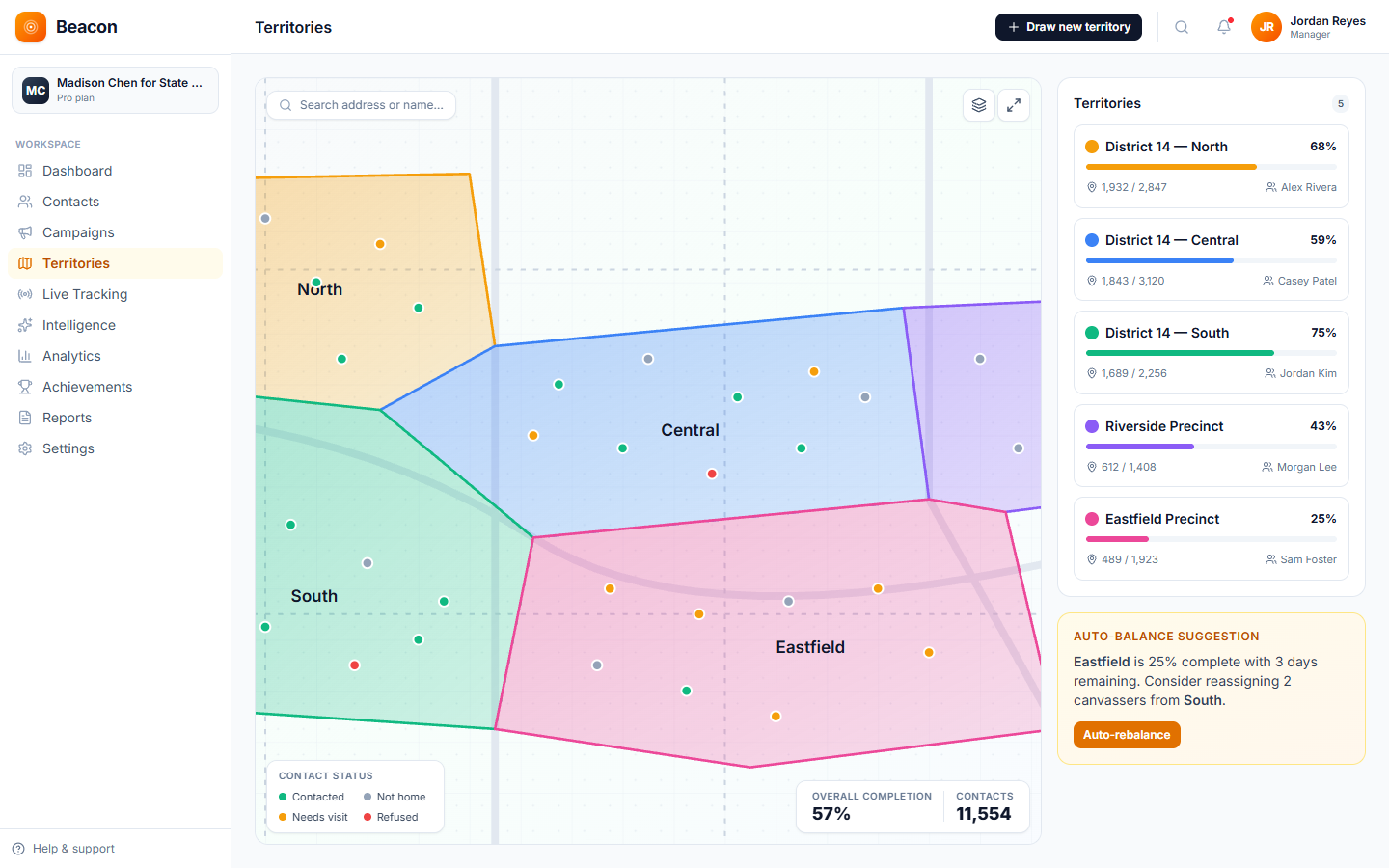
Residents get surveyed at the door, support level gets tagged, and multilingual capture works for every household. The map shows where your movement has strength and where it doesn't, block by block — and grassroots canvassing software turns grant reports that took two weeks into a single click.
— Blocks & support
Polygon a neighborhood or a coalition footprint and watch support build as organizers walk it — strong-support blocks turn dark, undecided blocks stay light, and opposition shows up as a flag. It's the map you bring to the elected official's office.
— The platform
No clipboard surveys piling up unread, and no coalition partner working off a different spreadsheet — every listening conversation writes to the same record the lead organizer sees on the support map.
/01 — DESK
Cut blocks and neighborhoods, build issue surveys, and assign organizers as the support map fills in — the dashboard the lead organizer runs the campaign from.
/02 — DOOR
The mobile side of the platform, with the listening list, resident screen, multilingual conversation guide, and sync queue all running on a block organizer's phone. Anything captured without cell signal is held locally and synced when the connection returns.
/03 — MAP
Each listening session updates the map as it happens, so support level by block, top issues by neighborhood, language reach, and coalition-partner contributions are all visible on the dashboard for funder reports and elected-official briefings.
— Multilingual
Tag every resident with their preferred language and the next organizer who knocks gets the survey, the script, and the issue framing in Spanish, Mandarin, Vietnamese, Korean, Arabic, or any of the 12 supported languages. Communities that used to get skipped because nobody on the volunteer crew spoke Spanish — those communities don't get skipped anymore.
— How a campaign runs
It's the same loop whether you're surveying 200 residents on a single block or running a coalition campaign across an entire ward.
/01
Polygon blocks, neighborhoods, and coalition territories, and the resident list inside becomes a listening list — per-block quotas keep coverage balanced across coalition partners.
/02
Build a custom survey with the questions that matter to your campaign — it translates into the languages your community speaks, and organizers see the prompt in the resident's preferred language.
/03
Block organizers run the resident screen, capturing issue priorities, support level, and willingness to act — all offline-safe so it queues for sync the moment signal comes back.
/04
The support map updates live and top issues bubble up by neighborhood — with a one-click grant report for funders and a one-click constituency map for the city-council meeting.
— Campaign types
An issue-identification listening tour and a get-out-the-meeting push for a city-council vote aren't the same job, so the platform configures around what each campaign is trying to accomplish.
Before the campaign has a target, you need to know what residents actually care about — open-ended issue capture, top-of-mind tracking, and demographic cross-tabs form the foundation under everything that comes next.
Captures: Top Issue · Concern · Demographic · Willingness to Act
When the issue is clear, the work is finding the residents who care enough to act — support level tagging, contact ladder progression, and recruitment to neighborhood meetings and core teams.
Captures: Strong · Leaning · Undecided · Will Volunteer · Core Team
When the council votes Tuesday, you need 200 residents in the chamber Monday night — targeted door knocks, ride coordination, attendance tracking, and follow-up the day after.
Captures: Committed · Needs Ride · Attended · Will Speak
— Organizer FAQ
/Q — LANGUAGES
Tag each resident with a preferred language and the conversation guide and survey questions appear in that language for the organizer at the door. 12 languages are supported, including Spanish, Mandarin, Vietnamese, Korean, and Arabic.
/Q — COALITION
Yes — coalition partners can share resident records, see contributions by partner, and coordinate without duplicating door knocks. Each partner sees their own assignments plus the shared coalition view.
/Q — PRICING
No — pricing is by the size of the resident contact universe, not organizer count, so bring 5 paid organizers or 200 volunteers for the same price. There are six tiers, from Starter at $59 (2,500 contacts) up to Enterprise at $599 (250K+).
/Q — REPORTING
One-click impact PDFs by neighborhood, demographic, language reached, top issues, and dates — funders get the breakdown they need without your team spending two weeks in spreadsheets the month after a campaign closes.
/Q — OFFLINE
The mobile app keeps working without cell signal — listening sessions save to the phone and sync when signal returns, so no organizer ever loses a survey response because they walked into a stairwell or down a side road.
/Q — SETUP
Most campaigns are listening inside three days — same-day account, with the footprint polygon drawn during onboarding and organizers downloading the app the same afternoon. White-glove onboarding runs $249–$999 for coalition launches.
— Start listening
Open an account, draw your campaign footprint, and build your issue survey. Within a few days your block organizers will be out walking with multilingual capture available on their phones, and the support map will be updating live for the lead organizer.